
Why Does Installing a Ridge Vent Near a Roof-Mounted Attic Fan Cause Ventilation Problems?
Attic ventilation is one of the most misunderstood systems in residential roofing. Many homeowners assume that adding more ventilation products automatically improves performance. In reality, mixing incompatible exhaust systems can distort airflow, trap heat, and reduce the effectiveness of the entire roof.
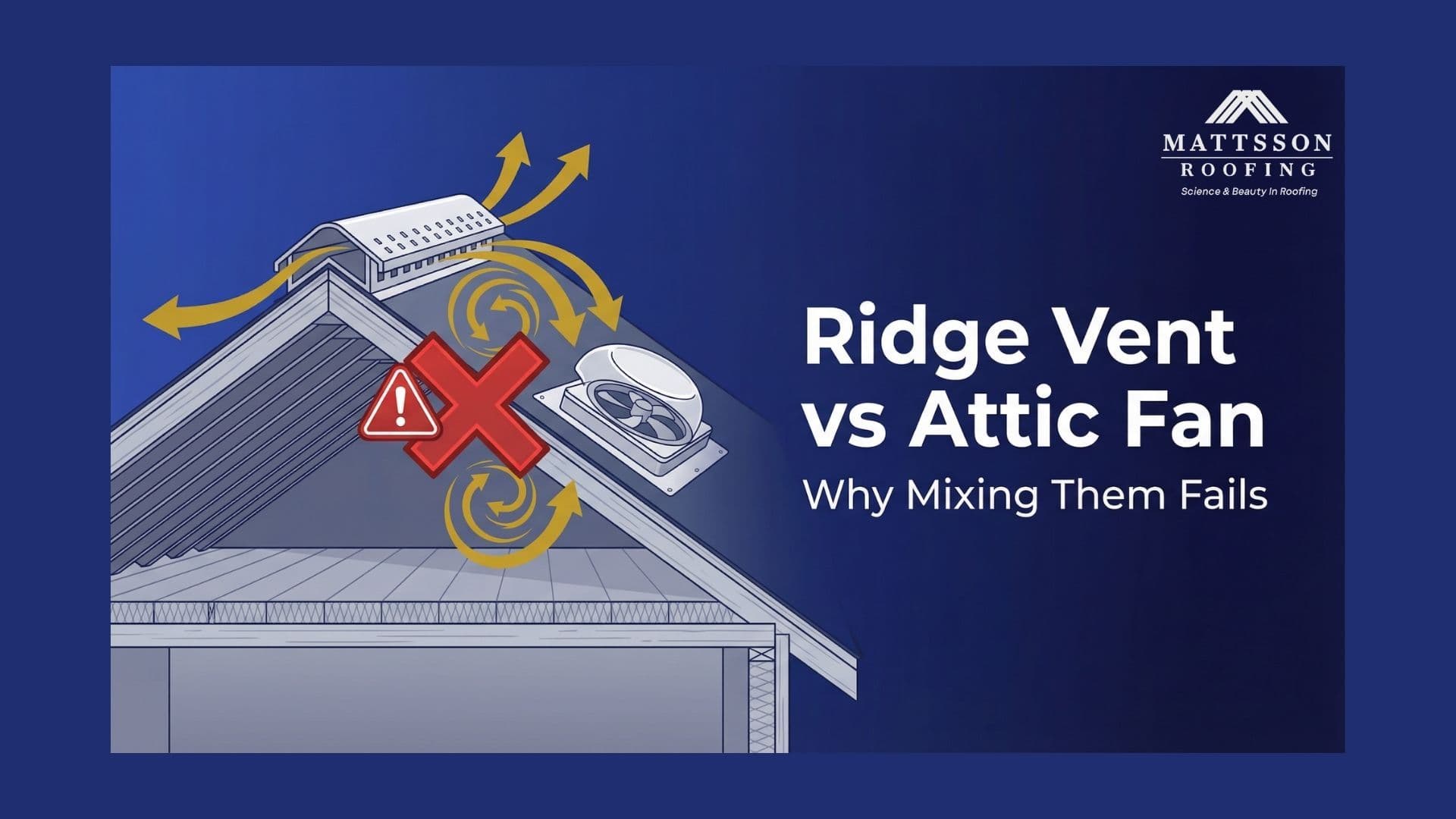
One of the most common issues we see during inspections in Bergen County occurs when a roof-mounted attic fan is installed just a few feet below a ridge vent. While both systems are designed to exhaust hot air, placing them too close together causes the ventilation system to work against itself.
Understanding why this happens requires looking at how each system is supposed to function—and what changes when they compete.
How Is a Roof-Mounted Attic Fan Supposed to Work?
A roof-mounted attic fan is a mechanical exhaust system. It is typically controlled by a thermostat, often set around 95 degrees. When attic temperatures reach that point, the fan activates and begins pulling hot air out of the attic.
In a properly designed system, the fan:
Pulls air from the entire attic space
Relies on adequate intake ventilation, usually through soffits
Exhausts hot air evenly rather than from one concentrated area
When paired correctly with balanced intake ventilation, an attic fan can help reduce excessive heat buildup and improve overall attic performance.
As explained during this inspection:
“When the attic hits 95 degrees, this fan will activate and start to churn and pull out air from the attic, which is great.”
The problem does not come from the fan itself—it comes from what happens around it.
How Is a Ridge Vent Supposed to Work?
A ridge vent is a passive exhaust system installed along the peak of the roof. When the ridge is cut open, hot air naturally rises and escapes through the vent due to convection.
A ridge vent works best when:
It is the primary or only exhaust system
Intake ventilation is properly balanced
Airflow is allowed to rise naturally from soffit to ridge
Because it relies on natural airflow rather than mechanical force, a ridge vent is designed to ventilate the entire attic evenly over time.
What Happens When a Ridge Vent Is Installed Too Close to an Attic Fan?
Problems begin when these two exhaust systems are installed within just a few feet of each other.
When the attic fan turns on, it looks for the easiest place to pull air from. If a ridge vent is only three feet away, the fan no longer pulls air from the entire attic.
Instead, it pulls air directly from the ridge vent.
As described on site:
“Rather than the attic fan circulating air from the entire attic, it’s now pulling air from three feet up.”
This completely changes how the ventilation system behaves.
Why Does the Attic Fan Pull Air Backward Through the Ridge Vent?
Air always follows the path of least resistance. When the attic fan activates, the ridge vent becomes the closest and easiest source of air.
Instead of exhausting air through the ridge vent, the system reverses:
Air is pulled inward through the ridge vent
The ridge vent stops functioning as an exhaust
Air travels directly from the ridge vent to the attic fan
This creates a short, tight airflow loop.
As explained during the inspection:
“Instead of having this fan churn from the whole attic, it’s pulling air into the ridge vent—which is supposed to exhaust air—and sending it right out to the attic fan.”
Which Parts of the Attic Actually Get Ventilated When This Happens?
Only a very small section of the attic benefits from airflow.
Specifically, the three-foot space between the ridge vent and the attic fan is the only area experiencing any meaningful air movement when the fan turns on.
“The only space in this attic that’s getting any form of air circulation when this turns on is this three-foot space.”
The rest of the attic becomes stagnant.
Why Does the Rest of the Attic Overheat in This Setup?
Hot air naturally wants to rise. A properly functioning ridge vent allows that air to escape vertically at the highest point of the roof.
When a mechanical fan begins pulling air sideways toward itself, that natural pattern is disrupted.
Instead:
Hot air no longer rises evenly to the ridge
Airflow distorts toward the fan
Large sections of the attic trap heat
As described on site:
“The air will distort rather than rising up to the ridge. It’ll go toward the fan. The whole rhyme and reason of the ventilation system has been distorted.”
Over time, this can lead to:
Higher attic temperatures
Increased strain on HVAC systems
Premature shingle aging
Greater moisture and condensation risk in colder months
Why Doesn’t Adding More Exhaust Ventilation Improve Performance?
Ventilation systems only work when airflow is intentional and balanced.
Adding multiple exhaust products without system design creates competition rather than improvement.
For ventilation to work correctly:
Intake and exhaust must be balanced
Airflow paths must be deliberate
Exhaust systems must not compete
Installing two exhaust systems within a few feet of each other violates all three principles.
“You put on two different exhaust products… both three feet away from each other.”
Instead of improving airflow, the system cannibalizes itself.
What Is the Correct Way to Design an Attic Exhaust System?
The solution is simple but non-negotiable: use one exhaust strategy per attic area.
As stated clearly during the inspection:
“Stick to one exhaust ventilation form.”
That means choosing either:
A ridge vent system designed for passive, full-attic airflow
orA mechanical attic fan system supported by proper intake ventilation
—but not both together in the same zone.
Which approach is correct depends on:
Roof design (gable vs. hip)
Attic size and layout
Existing intake ventilation
Home orientation and heat load
This is why attic ventilation should always be evaluated as a system, not a checklist of parts.
Why Is This Problem Common in Bergen County Homes?
In towns like Glen Rock, Ridgewood, Wyckoff, Franklin Lakes, and Fair Lawn, ventilation systems are often modified over time.
Different contractors may:
Add a fan years after a ridge vent
Install a ridge vent without removing an existing fan
Solve one symptom without reevaluating the whole system
The result is conflicting airflow and underperforming ventilation.
A trusted roofer in Bergen County should always evaluate how all ventilation components interact—not just whether they exist.
How Can I Schedule a Roofing Inspection in Bergen County?
For homeowners in Bergen County looking for peace of mind with their roof, Mattsson Roofing is here to help. Our inspections focus on understanding the entire roofing system—not just spotting surface issues.
Contact Us
Mon-Fri: 7:30am - 5pm
Sat: Appointment Only
Sun: Closed