
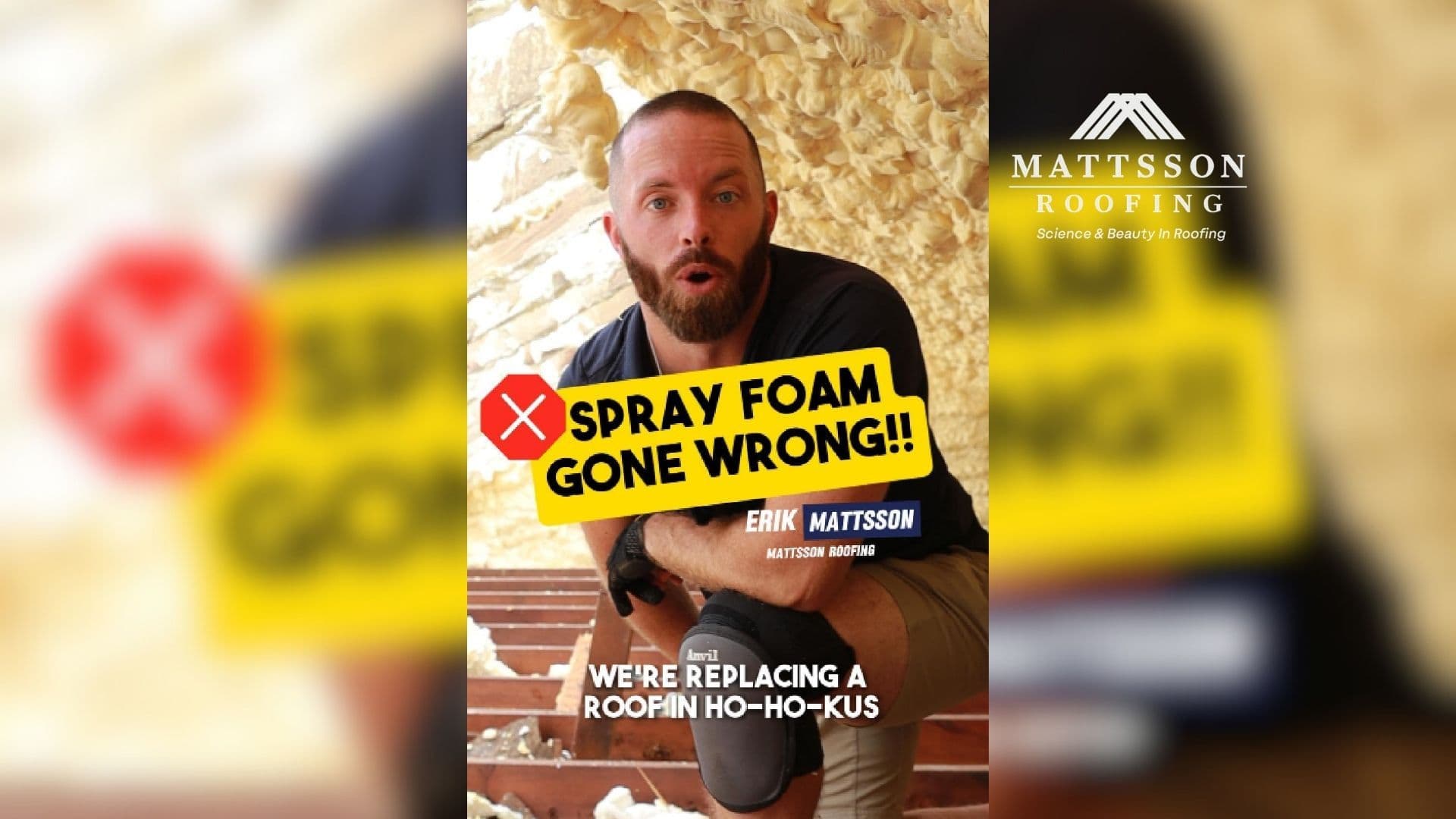
What Happens If I Have Spray Foam Applied Directly to My Roof Decking?
Homeowners across Bergen County often ask whether spray foam insulation is a smart upgrade. While spray foam can be effective in the right application, problems arise when it is applied directly to the underside of roof decking. This issue frequently surfaces during roof replacements—and it can create unexpected complications if homeowners are not aware of how roofing systems work together.
What Does It Mean When Spray Foam Is Applied Directly to Roof Decking?
Spray foam applied directly to roof decking means the insulation has been sprayed onto the underside of the plywood or OSB that supports your shingles. Instead of insulating at the attic floor level, the foam adheres to the roof structure itself.
During a roof replacement in Ho-Ho-Kus, this condition became immediately visible as the old roofing materials were removed. As the decking was exposed, pieces of spray foam detached and fell away with the wood.
As explained during the project, “the spray foam is coming out as we're replacing the roofing system,” which is not an isolated occurrence—it is a predictable outcome of this installation method.
Why Is Spray Foam on Roof Decking a Problem During Roof Replacement?
Roof replacements require direct access to the roof decking. Shingles, underlayment, and sometimes sections of wood must be removed or replaced to ensure the new roof performs correctly.
When spray foam is bonded to the underside of that decking:
Any damaged wood that must be replaced will pull the foam with it
Foam can fracture, crumble, or detach during demolition
Insulation integrity is compromised even if the foam initially remains in place
In practical terms, this means insulation damage is almost unavoidable once roof work begins.
Does Spray Foam on Roof Decking Damage the Wood Over Time?
In many cases, yes.
Roof decking needs the ability to dry. When spray foam is applied directly to the wood, it can trap moisture between roofing layers and the decking itself. Over time, this trapped moisture may lead to rot, delamination, or structural deterioration.
During inspections, Mattsson Roofing often finds that when spray foam is bonded directly to the roof deck, “it has probably already ruined the roof decking.” Even if deterioration is not immediately visible, the risk increases significantly compared to traditional attic insulation approaches.
Why Do Homeowners Choose Spray Foam for Roof Decking in the First Place?
Most homeowners do not intend to create a roofing problem. Spray foam is often marketed as:
Highly energy-efficient
Air-sealing and moisture-resistant
A long-term solution for comfort and efficiency
The misunderstanding occurs when spray foam is treated as a standalone upgrade rather than part of a complete building system. Roofing, ventilation, insulation, and moisture control must work together. When one component is changed without considering the others, unintended consequences follow.
Can Spray Foam Be Installed Correctly Without Causing Roofing Issues?
Yes—but placement matters.
Spray foam can be effective when:
Installed at the attic floor instead of the roof deck
Paired with a properly designed ventilation system
Evaluated alongside roof age and replacement timelines
Problems arise specifically when foam is adhered directly to decking without considering future roof work or the need for airflow and drying potential.
What Happens to Spray Foam If Roof Decking Needs to Be Replaced?
If decking replacement is required, the spray foam will almost always be impacted. In many cases, the foam must be fully removed.
As noted during the Ho-Ho-Kus project, “if we need to replace all of that wood on the top of your house…the spray foam is gonna come out with it.” This is not due to poor workmanship during roof replacement—it is simply the physical reality of how these materials interact.
Is It Better to Remove Spray Foam During a Roof Replacement?
From a long-term perspective, yes.
Once spray foam has been disturbed or compromised, leaving it in place can result in:
Gaps in insulation coverage
Reduced energy performance
Hidden moisture risks
Removing damaged foam allows the roofing system to be rebuilt properly and gives homeowners the opportunity to reassess insulation strategies that align with ventilation, moisture control, and future serviceability.
What Should Homeowners Know Before Replacing a Roof With Spray Foam Present?
Before any roof replacement, homeowners should understand:
Where insulation is installed
Whether roof decking can be inspected and dried
How insulation choices affect future repairs
This is why inspections matter. According to Mattsson Roofing’s inspection process, evaluating insulation and decking conditions early helps prevent surprises once work begins.
How Does This Affect Homes in Bergen County Specifically?
Homes in Bergen County towns such as Ho-Ho-Kus, Ridgewood, Glen Rock, Wyckoff, and Franklin Lakes often experience seasonal temperature swings and humidity changes. These conditions make proper ventilation and moisture management especially important.
When spray foam blocks drying potential at the roof deck, the regional climate can accelerate hidden damage—making system-level evaluation critical rather than relying on insulation alone.
What Is the Correct System-Level Approach to Insulation and Roofing?
A proper approach considers:
Roofing materials
Decking condition
Ventilation design
Insulation placement
Long-term maintenance and replacement needs
Rather than treating insulation as a single upgrade, it should support the roof as a complete system. This philosophy helps ensure durability, performance, and fewer disruptions over time.
How Can I Schedule a Roofing Inspection?
For homeowners in Bergen County and surrounding areas looking for peace of mind with their roof, Mattsson Roofing is here to help. Our inspections focus on understanding the entire roofing system—not just spotting surface issues.
Contact Us

Mon-Fri: 7:30am - 5pm
Sat: Appointment Only
Sun: Closed